[Orig to FB]
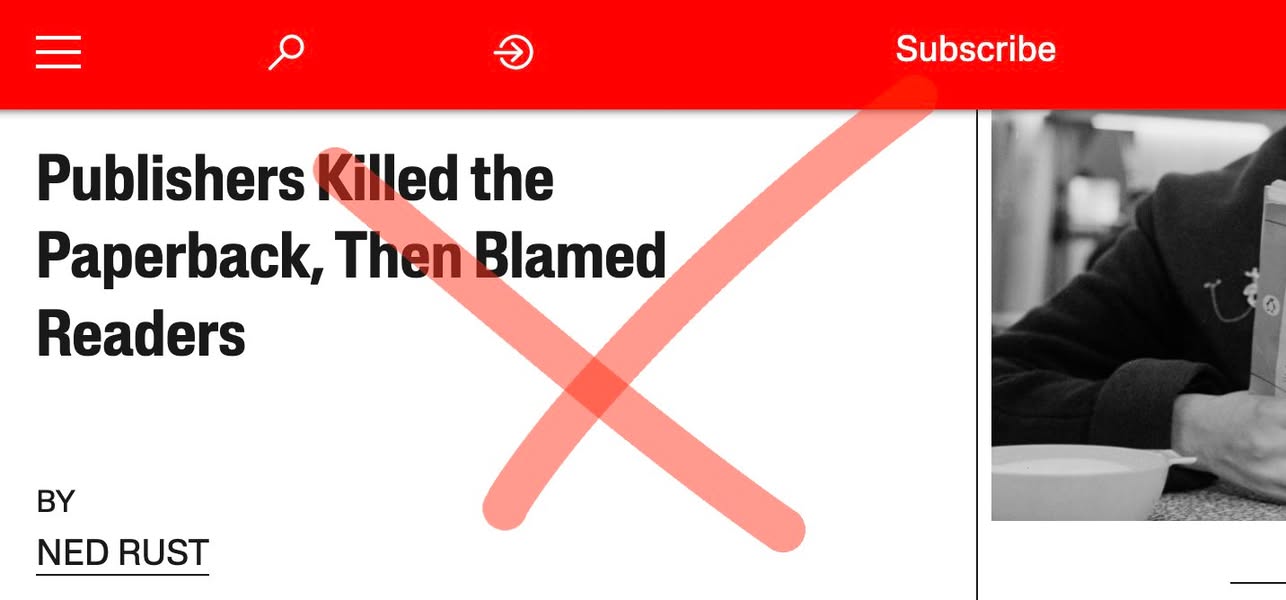
I don’t really want to pick on Jacobin too much, but how in T living F do you write a potted cultural history of the rise and fall of the paperback from the late 1930s to now without once mentioning the 1950s, 1960s, 1980s, 1990s, 2000s, or 2010s? I left out the 1970s because 1979 gets mentioned once! — as the high point of paperback sales (see below for why things collapsed after that). Just “for many decades,” “decades-long…binge,” and “intervening decades,” IOW I-can’t-be-arsed handwaving. TV and radio get one mention each, but only as metonyms for some magical e-media-free landscape. Newspapers? Nope. Magazines? Nope. The latter are especially important in this context because their ebbs and flows say a lot about America’s reading habits — for ex, the explosion of mag titles from the early 1960s on, the rise of “new journalism,” and the death of several old standards in 1971, plus or minus. Cable TV? Not a mention. Movies get a few, again mostly as foils. THE INTERNET? Not explicitly, just as the unnamed presence behind “school-issued personal video devices.” Textbooks? Nope. Distribution? A few cursory comments. Libraries? Once — and not in the context of hardcovers, so no mention of institutional sales (essential for understanding hard- vs softcover market dynamics). If that all weren’t enough, the key material development he left out was the rise of the “quality” — larger format —paperback in the 1970s. How large? The same size as hardcovers! Why? Because the only difference was the binding! Why? Because selling cheap paperbacks wasn’t as financially sustainable as selling the same interiors in different wrappers. (Ah, right: other things that get no mention: “finance,” “economics,” “profit,” “loss”…but I digress. 😹) Another consideration that merits no mention: printing. Ask me about the rising costs of it — in a former life, I was a print broker for some small presses in the US and Latin America.) And don’t even get me going on the Supreme Court ruling that demolished the core biz model that sustained the cheap paperback biz, which was (1) print zillions of copies and warehouse them, (2) write the whole cost off, (3) sell the tax-free inventory for decades to come. Until Thor Power Tool Co. v. Commissioner, the 1979 ruling that transformed how businesses could account for inventory. That was when publishers cost-shifted inventory to distributors, who didn’t GAF about content: if a title didn’t sell, they pulped it. After that, backlists — which previously had been inventory — just became IP. And that, my friends, is why paperbacks died from 1980 on. I’d love to applaud this piece and Jacobin for running it, but I just can’t.