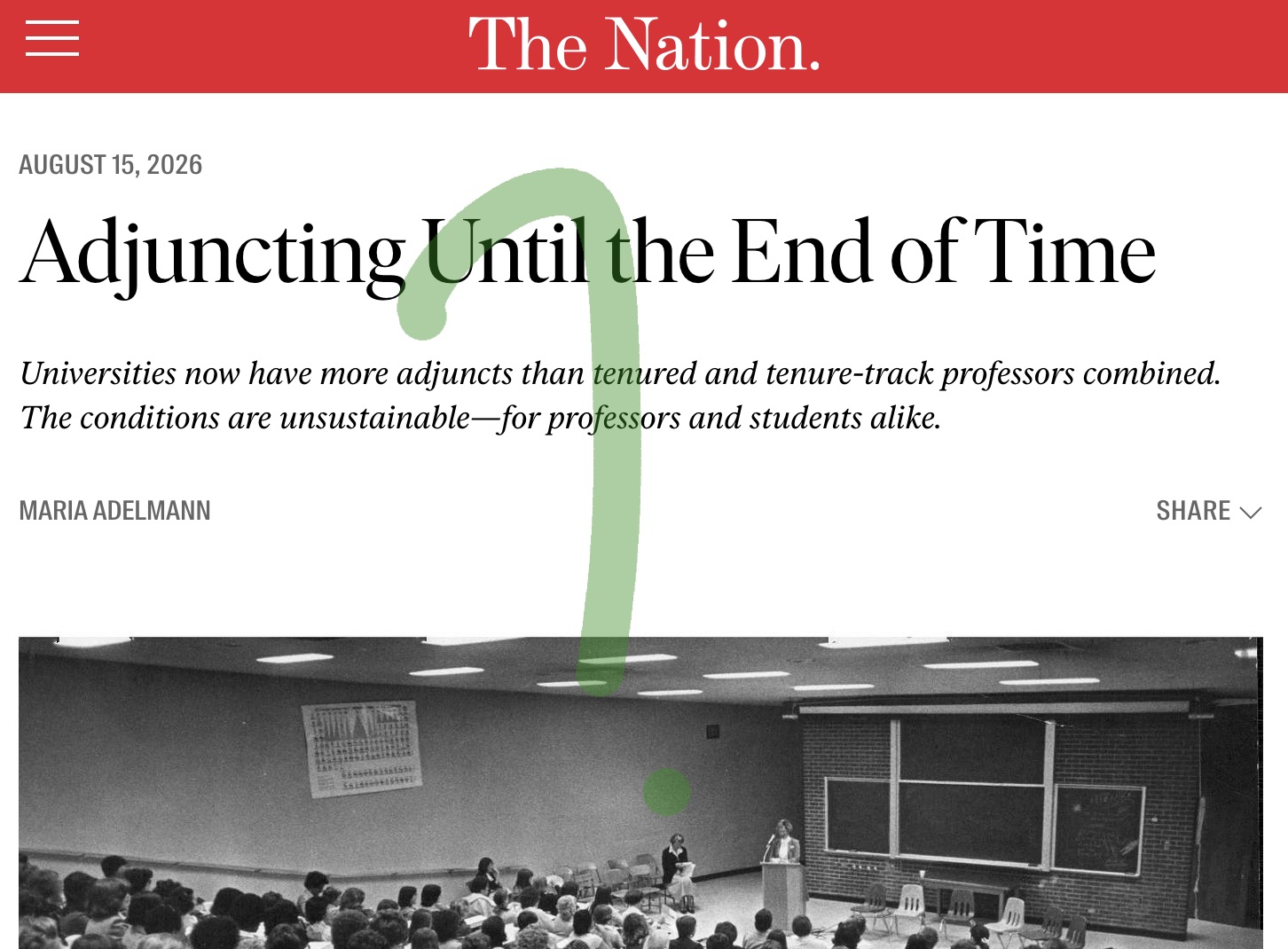
Stories like this have been a dime a dozen for decades, but I’d have to stretch my mind to think of any I’ve read that consider one of the most significant factors driving this trend: the expansion of practical degrees across higher ed. In many of those “new” fields and programs, expertise and relevance are established through practice across the field rather than research within the institution — so, for many purposes, adjuncts are often preferable to full-time faculty. And that assumes there even are qualified candidates for FT jobs. And that, in turn, raises the question of what “qualified” means: traditional academic credentials like a PhD? Some other terminal degree like an MFA or MS? (It’s only very recently that degrees like that have been accepted as legit grounds for FT jobs, let alone tenure-track jobs.) So, basically, the normative assumption driving pretty much all coverage of this subject over the last 25 years is that “traditional” faculty jobs in the humanities and social sciences are the notional baseline — even as those sectors have been shrinking in both absolute and relative terms. None of what I say here is a generic defense of higher ed’s turn toward mass-adjunctification. To be clear, much of it is abusive and I don’t support it. But the sad fact is that ostensibly critical coverage of this issue is basically a highbrow version of tradwife rhetoric: rooted in dying worlds, and waxing nostalgic for visions of it that never actually existed to begin with. But you won’t hear academics say any of this, because…well, now, that is an interesting question.