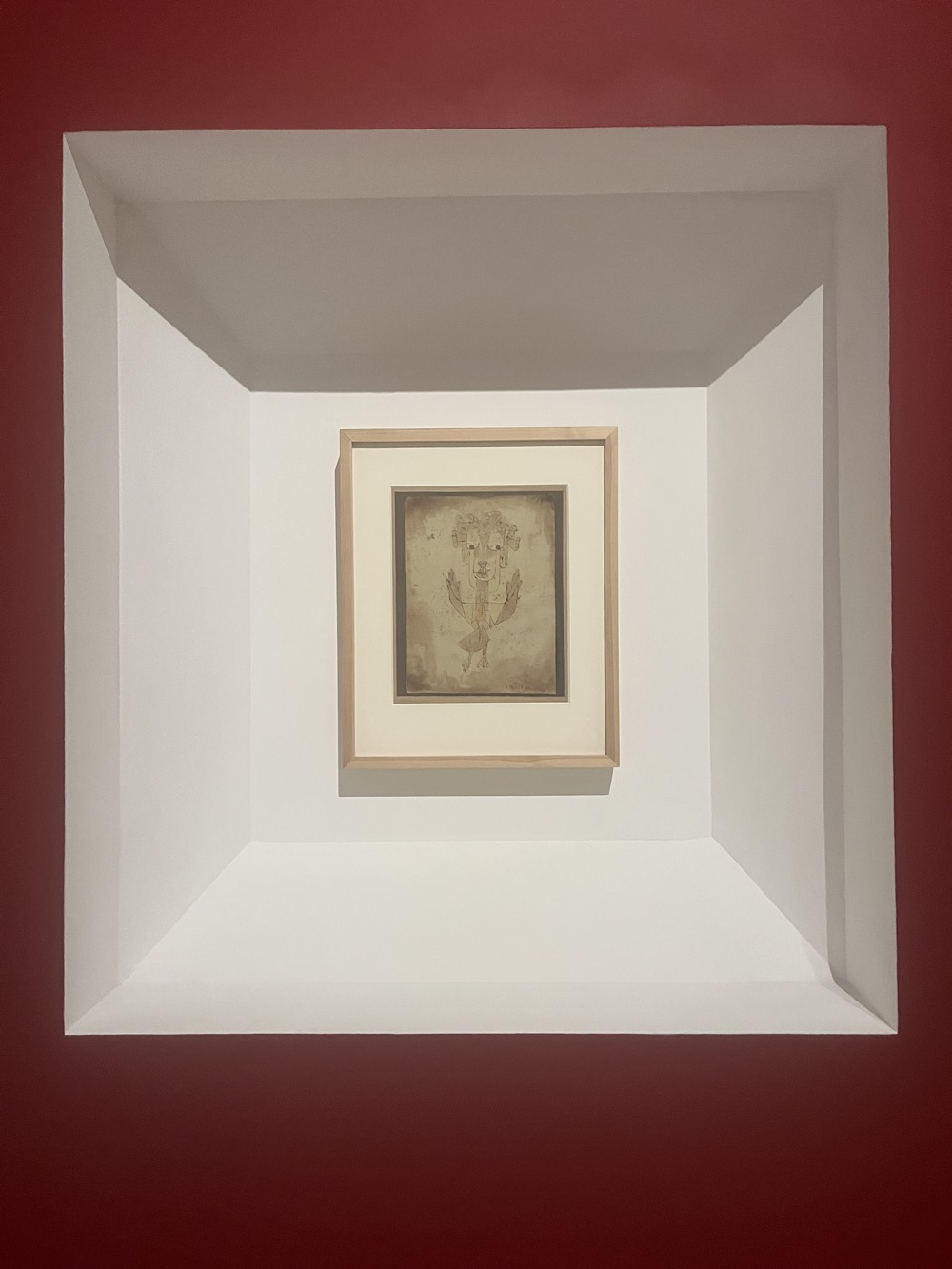
So…Partner and I went to the Jewish Museum today to see the Klee show — really enjoyable except maybe for the wall texts, which, as always now, are committed to reducing all art to veiled didacticism. But one thing perplexed me: Klee’s Angelus Novus was there. You know the one: a so-so cartoon that’s been elevated to the Mona Lisa of Modernity because Walter Benjamin wrote about it in “Theses on the Philosophy of History.” I have a thing about this, because my mentor Morton Smith did his dissertation at Hebrew U with Benjamin’s BFF, Gershom Scholem. before he fled Paris, Benjamin gave the print to Bataille, who gave it to Adorno, who gave it to Scholem right after WW2 — when Smith was studying with him.
Learning about that living connection in the mid-’80s, when Benjamin was going platinum in theory circles, was the kind of thing that changes how you read a ‘text’ — like his Theses. And a few years after I graduated I was working freelance for Pantheon / Schocken and because of that relationship got handed a life-changing project: the manuscript of the Correspondence of Benjamin and Scholem, with the plea to “fix it.” The translator, I was told, had farmed it out to grad students, who bungled it up six ways from Sunday. I spent the next few months poring over that thing, trying to salvage it, and judging by the reception it seems I succeeded. So the Benjamin–Scholem connection is very vivid thing for me.
These were the years of high Reaganism and Bush 1, a time when the humanities were busy politicizing everything, which in practice often meant redefining politics so it was more at home between the covers of journals like October than on the streets. That was the context in which Benjamin’s famous passage about Angelus Novus became a left-critical anthem, and that shaped how I read it — with more emphasis on Rezeption than Produktion. I felt then, and still feel, that the passage became popular because it served as a mawkish fetish that academics identified with to excuse themselves from engaging in serious political struggle.
…which brings us back to today at the Jewish Museum. I mean, OMG, here it actually is, a print that passed through the hands of Klee, Benjamin, Adorno, and Scholem. It’s practically the font and origin of Benjamin’s theory of aura! They should be handing out solar eclipse sunglasses to protect viewers from the piece’s blinding aura, right?! Nope. Near, far, left, right, sitting, standing — no aura. Walk around and look at the rest of the show, come back. Still no aura. OK, self, you’ve ‘seen’ it so many times, try to unsee it, right? What better place to do that than a Klee exhibition: more than almost any other artist, he taught us how to see, unsee, see anew, see differently… No dice. I probably have a few postcards of that print with far more aura.
How can that be?! How can it be such a dud? Well, it turns out the Angelus Novus on display is an “authorized facsimile” — a fake. The real one was supposed to be on display but isn’t. The wall text says (a bit too discreetly, imo) that “Due to current conditions affecting international transport“ — that’d be the war of choice that Israel and the US co-launched against Iran — ”the shipment of the original artwork has been temporarily delayed.”
On second thought I have a theory: the copy on display has a different kind of aura, a distinctly 21st-C American one: an aura of fakery, of absence, of euphemism, all of it intertwined in some strange way with war that’s both emptily false and brutally real.
Either way, though, that Benjamin passage? Not anymore.