[Orog to FB]
This Hyperallergic story about the New School catastrophe is much better than that Gothamist rubbish from a few days ago.
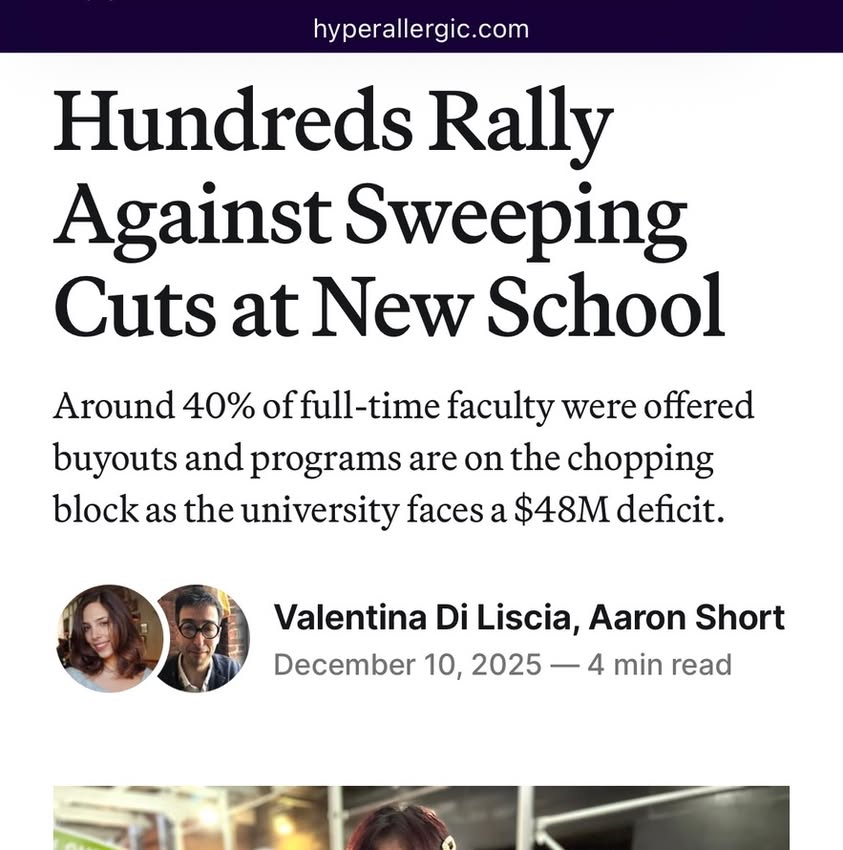
One aspect of this fracas that won’t be obvious to anyone outside of TNS (or even to many within it, amazingly) is the imbalance in which parts of the university are speaking out: it’s all full-time faculty in SSH (i.e., social science and humanities) fields and adjuncts in art and design. What I’m not seeing are full-time faculty from Parsons complaining too loudly. It’s hard to interpret that — for a few reasons, which are worth getting into, imo.
Coverage of TNS has always been lopsided that way. In quant terms, Parsons is the majority of TNS — about 50% of its student body and, last I knew, around 80% percent of its budget. So any coverage that wasn’t founded on that simple fact — i.e., all of it — was distorted by definition. There are reasons for that bias. I’ll lift a line from that big sign in Trenton to make this point in the crudest terms: DESIGN MAKES, SSH TAKES. Design is measured by what you make, not your interpretations or opinions, and even now pedagogy in that field still emphasizes client relations: flexible, pragmatic, collaborative. In that respect, design really is much more like science now, with teams that sprawl across many subdisciplines and constituent practices, than SSH fields, which eve now are deeply rooted in romanticist models of individual inquiry, experience, and expression. Upshot: it’s easier to get soundbites from SSHers.
But there’s another possibility here. When SSH faculty say the TNS admin in trying to “radically diminish the power and capacity of the liberal arts divisions” and “decimate historic spaces of critical inquiry and social justice,” I think there’s an implicit (and maybe even unwitting) polemic that isn’t aimed at the administration. If the admin is isn’t making such severe cuts to Parsons, that might be because Parsons pays everyone’s bills. If the cuts focus mainly on parts of the university outside of Parsons, as I suspect, then many of them are long overdue. And, as is usually the case with problems that have been allowed to fester, the cure is much, much worse than it needed to be.
Way back when, I headed up a surprisingly interesting survey of faculty office needs for the senate. In the design school, I shared my own office with seven other full-time faculty members; many other full-time design/art faculty had no office at all, just shared “hot seats.” Interviewing SSH faculty was a serious eye-opener. One sociologist confided that in fields like hers every faculty member needed a private office because — in her words, which she regarded as utterly self-evident — “We talk.” I asked her to clarify, and she explained that they “actually talk.” As she went on, it became crystal clear that, in her mind, the half of the school that pays the bills for her and her colleagues to talk doesn’t actually talk — so they don’t need offices. The kicker was that her arrogant pretensions were widely representative; it was only her obtuse willingness to say the quiet part out loud that stood out.
But that exchange was emblematic of a systemic bias that most people who’ve served on arts faculties know well: your field, your work, your students, are regarded as unserious, not even intellectually lightweight because no intellect is involved — it’s all optional, excessive, decorative, something to either be explicitly appreciated or implicitly instrumentalized (e.g., collaborations where SSHers do the ‘content’ and designers do the web design or whatever). The fact that “design” shapes every aspect of our lives from birth to death, and even defines many of them, is incomprehensible; and the fact that many people came to it through all kinds of strange paths, and bring that expertise with them, is unheard of.
Those assumptions are deep-seated and pervasive and in SSH fields, and should be understood as backstory for comments like the ones quoted above: about “radically diminish[ing] the power and capacity of the liberal arts divisions” and “decimat[ing] historic spaces of critical inquiry and social justice.” What’s being defended may well be a largely imaginary privilege — for example, to “actually talk” while the vocational subalterns in those other building do whatever it is they do — look at things, click on stuff, pick out colors, decorate, etc.
This wasn’t limited to office space, of course: it also described political access, budgeting, central admin staffing, workloads, compensation and perks, job security, class size, IT and library issues — even furniture, FFS. And SSH faculties weren’t just benignly clueless about any of this. When serious issues arose where Parsons faculty would have benefited from solidarity from SSH faculty in the other divisions, they were usually nowhere to be seen — or, worse, on the wrong side. For example, when TNS harmonized its faculty structure, quite a few SSH faculty members, including some of the most powerful ones, were outspoken and active in their opposition to extending job security and status to Parsons full-time faculty. I could rattle off many such examples.
Now, the flipside of my remarks here needs to be made explicit: focusing on the fact that art and design bring in the bucks tacitly suggests that universities should be managed according to market principles. I do not believe that. On the contrary, when you strip away all the disciplinary insider baseball and look at a university as a contraption, its quintessential operations is cross-subsidization. Undergrads pay for grads, some programs are profitable while others are perennial losers, and so on. And that cross-subsidization isn’t just financial, it’s also metaphorical; some divisions / schools / departments / faculty are prestigious or famous or just very effective, while others are not. That’s not a necessary evil, it’s good and right. Up to a point.
But as far as I know, and I know about as far as anyone, the TNS / Parsons relationship has never been up to that point, it has only ever been far, far past it. Again: If the cuts are mostly outside of Parsons, they’re overdue — and much more severe than they would have been.
tl;dr: the tired tropes about how this is “really” an attack on the critical spaces of the humanities and social sciences can equally be read as (sorry for the Lukács ref, kids!) false consciousness.